Breast Surgery
Breast Surgery in Melbourne (Mammaplasty)
Dr Rodrigo Teixeira (FRACS) is a Specialist Plastic Surgeon offering breast surgery in Melbourne. This includes cosmetic and functional procedures. Each treatment is planned for the person. It aims to restore comfort, balance, and proportion in keeping with the patient’s anatomy and goals.
About Breast Surgery (Mammaplasty)
Breast surgery, or mammaplasty, covers procedures that reshape, reposition, or restore the breasts. These may be for aesthetic, functional, or reconstructive reasons. It may be considered by people with changes after pregnancy, breastfeeding, weight change, or ageing. It may also be considered by those wanting to address asymmetry, discomfort, or developmental differences.
Dr Rodrigo Teixeira (FRACS) is a Specialist Plastic Surgeon in Melbourne. He is experienced in both cosmetic and functional breast procedures. His approach brings together an eye for proportion and form. It aims to refine breast shape, size, and symmetry in a way that suits the patient’s body. Each plan takes into account the person’s goals, lifestyle, and physical needs. This supports results that balance aesthetic refinement with comfort and function.
Breast Augmentation (Implant or Fat Transfer)
Many patients describe feeling that their breasts never fully developed or have lost volume. This is especially so after pregnancy, breastfeeding, or changes in weight. Breast augmentation, or augmentation mammaplasty, uses implants or fat transfer. It may help restore fullness and balance between the chest and body proportions.
During consultation, Dr Rodrigo Teixeira carries out a physical exam. He checks breast measurements, tissue quality, and chest wall anatomy. Implant type, size, and pocket placement are chosen to suit the patient’s frame, tissue support, and goals. Fat transfer may also be used to improve contour or smooth the change between tissue and implant.
The aim is not simply to increase size. It is to achieve an enhancement in proportion that suits the body and restores balance. Each plan takes into account long-term tissue stability. It also considers the patient’s lifestyle and aesthetic preferences.
Breast Lift (Mastopexy)
Patients often describe their breasts as deflated or lower than before. They notice that bras or clothes no longer fit as they once did. A breast lift, or mastopexy, restores shape and position. It does this by tightening the skin envelope. The breast tissue and nipple are also repositioned for a more supported contour.
During consultation, Dr Rodrigo Teixeira assesses skin elasticity, nipple position, and remaining volume. This helps decide the most suitable technique. Some patients may benefit from combining a lift with augmentation to restore volume. Others may benefit from combining a lift with reduction to refine proportion and symmetry.
This procedure aims to restore balance and projection while keeping tissue support and softness. The goal is a breast shape that sits naturally with the body. It also aims to reflect the patient’s stage of life, anatomy, and expectations.
Reduction Mammoplasty (Breast Reduction)
Women seeking breast reduction often report neck or back pain, shoulder grooving, skin irritation, or trouble finding clothes that fit well. For others, the aim is to feel lighter and more balanced, both in body and in appearance.
Breast reduction, or reduction mammaplasty, reduces breast volume and reshapes the tissue. This aims to improve comfort and proportion. During consultation, Dr Rodrigo Teixeira discusses areas of discomfort. He assesses skin quality and how tissue is spread. He then plans the procedure to relieve symptoms.
A 2023 review of studies using the BREAST-Q questionnaire found that, after reduction, women reported better physical and psychosocial well-being and higher satisfaction with their breasts. Individual outcomes vary. Some cases may be eligible for a Medicare rebate when specific clinical criteria are met, and patients may be able to use their private health insurance. Out-of-pocket fees still apply.
Male Breast Reduction (Gynaecomastia Surgery)
Men considering surgery for gynaecomastia often describe chest fullness or an uneven contour. This does not improve with exercise or weight loss. The condition may be due to excess glandular tissue, fat, or skin. It can cause self-consciousness or discomfort in clothing and during exercise.
During consultation, Dr Rodrigo Teixeira assesses the type of tissue present and skin elasticity. This helps decide the right approach. Surgical options may include removal of glandular tissue, liposuction, or skin tightening when needed. Incisions are planned to be as discreet as possible and to keep a natural contour and symmetry.
The goal of treatment is to create a flatter, more defined chest. The aim is a chest that fits comfortably with the patient’s body shape and lifestyle. Recovery and results vary with the degree of correction needed. All decisions are guided by proportion, safety, and long-term stability.
Informed consent
Risks and Complications
All surgery involves some degree of risk. This varies with each person’s anatomy, health, and the type of procedure. Short-term bruising, swelling, and discomfort are common early in recovery.
Changes in nipple or skin sensation are common. They often improve over months, but can be permanent. Less common complications can include bleeding, infection, delayed wound healing, or visible scarring. Asymmetry, uneven contour, or changes in nipple position may occur despite careful planning.
Procedures with implants carry extra risks such as capsular contracture, implant rupture, or malposition. These may require further treatment or revision. Rare implant-related conditions include breast implant-associated anaplastic large cell lymphoma (BIA-ALCL), a type of lymphoma. Some people also report a range of symptoms called breast implant illness (BII). BII is not a formal diagnosis, and its cause is not known. Both are discussed during consultation.
Patients are given written information on implant types, safety data, and the expected lifespan of implants. This supports informed consent and long-term monitoring.
Any surgical or invasive procedure carries risks. Before proceeding, you should seek a second opinion from an appropriately qualified health practitioner.
Aftercare
Surgery and Recovery
Recovery after breast surgery varies from person to person. It depends on the type of procedure. Swelling, bruising, and mild discomfort are expected in the first one to two weeks. These usually ease with time. Most patients return to light activities within this period. Full recovery and tissue settling may take several months.
Follow-up visits with Dr Rodrigo Teixeira and his team are booked. They review healing, track progress, and give ongoing support. Dressings and support garments are usually worn for several weeks. They help maintain contour and comfort while tissues adapt. Patients are encouraged to stay in touch with the clinic during recovery for reassurance and guidance.
Optional recovery and scar management treatments are available at Unveil Aesthetics when clinically suitable. Detailed written aftercare instructions are given before surgery. They cover wound care, medicines, and activity advice. Healing times differ for each person. They are reviewed at follow-up visits to check that recovery is on track.
About Dr Rodrigo Teixeira
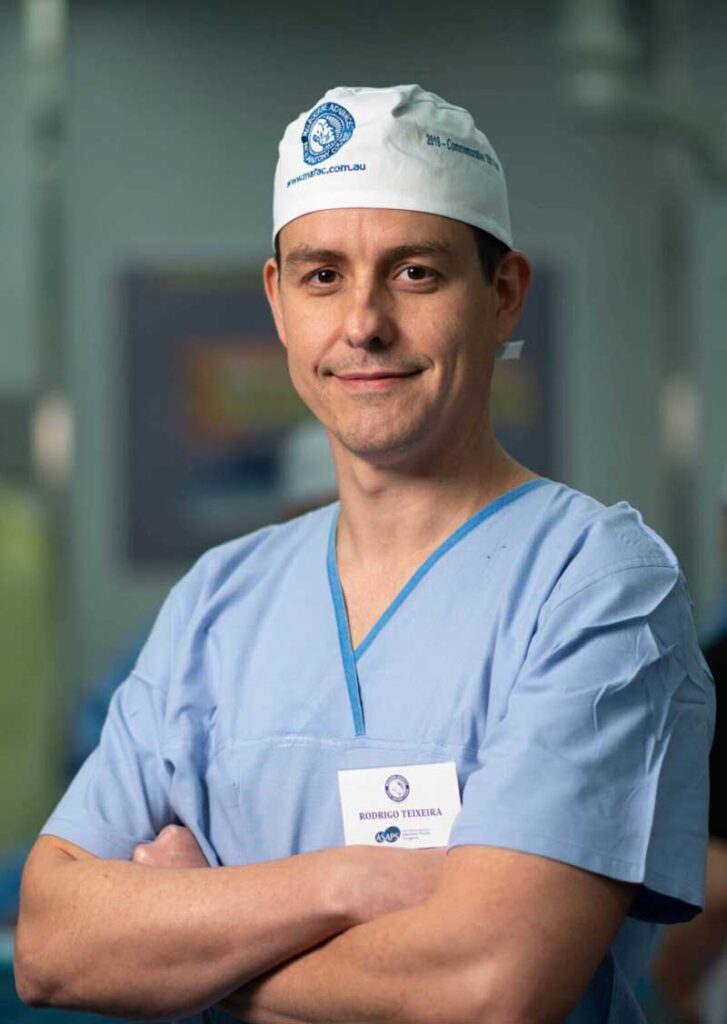
Dr Rodrigo Teixeira (FRACS) is a Specialist Plastic Surgeon (AHPRA MED1650480) based in Melbourne. His practice includes aesthetic and reconstructive breast surgery. He focuses on proportion, structure, and balance. He performs procedures such as augmentation, reduction, and lift surgery. He tailors each plan to the person’s anatomy and goals.
Dr Teixeira completed advanced fellowship training in Aesthetic Plastic Surgery, Craniofacial and Cleft Surgery, Paediatric Plastic Surgery, and Burns. This gives a broad base across reconstructive and aesthetic fields. His approach combines surgical planning with attention to detail, safety, and long-term tissue support.
He is a Fellow of the Royal Australasian College of Surgeons (FRACS, Plastic and Reconstructive Surgery). He is a member of the Australian Society of Plastic Surgeons, the Australasian Society of Aesthetic Plastic Surgeons, the American Society of Plastic Surgeons and the International Society of Aesthetic Plastic Surgery (ISAPS), and a faculty member of the Mendelson Advanced Facial Anatomy Course (MAFAC).
Learn more about Dr Rodrigo Teixeira and his qualifications.
Questions
Mammaplasty FAQs
The decision depends on your anatomy, goals, and symptoms. During consultation, Dr Teixeira discusses whether augmentation, lift, reduction, or a combination best addresses your concerns, explaining what each can and cannot achieve.
Scars are positioned to follow the natural folds of the breast and usually fade over time. However, their placement and extent depend on the chosen procedure and individual healing. Scar management options are discussed before and after surgery.
Most patients resume light activities within one to two weeks. Swelling and firmness gradually subside, but tissue settling continues for several months. Recovery timelines vary, and follow-up appointments monitor progress.
Breast implants are not lifetime devices. They may require replacement or removal in the future due to changes in the implant or breast tissue. Regular reviews and imaging help monitor their condition.
Some cases may be eligible for a Medicare rebate when specific clinical criteria are met, and patients may be able to use their private health insurance. Out-of-pocket fees still apply. Breast reduction and breast lift are examples where criteria may apply. Your cover can be clarified before surgery.
Gentle walking is encouraged early in recovery. More strenuous activities, including upper-body or impact exercise, are usually delayed for four to six weeks or until cleared by Dr Teixeira.
Journal
Plastic Surgery Blog
The Unveiling of Unveil Aesthetics and Plastic Surgery

Pain Management After Plastic Surgery