
Facelift terminology can be confusing. “Deep plane”, “SMAS”, “mini” and “endoscopic” describe different aspects of surgery, and they are not always separate or competing options.
A deep plane facelift mobilises the supporting layers of the face and neck, the SMAS and platysma, by working beneath them through natural tissue planes and spaces. Releasing key retaining ligaments allows these layers and their attached soft tissues to be repositioned and secured, providing deeper structural support with less reliance on skin tension.
Understanding how this differs from other approaches begins with the relationship between the facial layers, their attachments and the tissues being moved.
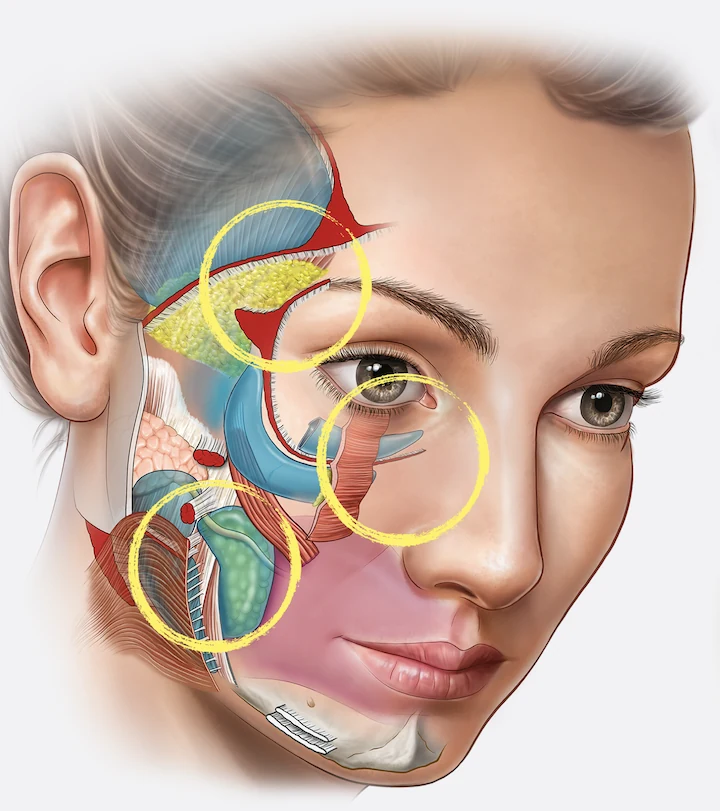
Understanding the layers of the face
The face is organised into interconnected layers. Beneath the skin lies subcutaneous tissue, including fat that contributes to facial shape and volume. Deeper still is the superficial musculoaponeurotic system, commonly called the SMAS.
The SMAS is a supporting network of connective tissue associated with some muscles of facial expression. Its composition and relationship to surrounding structures vary across the face; it is not a uniform sheet. In the lower face, this network connects with the platysma, the thin muscle extending into the neck.
Retaining ligaments connect the superficial tissues to deeper structures, including bone and deep fascia. Between areas of attachment are natural tissue spaces that accommodate movement during facial expression.
Facial ageing involves changes across this whole system. Skin quality, fat distribution, tissue support and bone structure may all change. Their relative contribution differs between individuals, which is why people age differently and may require different approaches.
What happens during a deep plane facelift?
The surgeon enters a plane beneath the SMAS in selected regions, works through natural tissue spaces and releases retaining attachments that limit movement. Where the procedure extends into the neck, dissection may continue beneath the platysma.
This allows the supporting layers and attached soft tissues to be mobilised together through the treated areas. They are repositioned to provide lift and reshaping, then secured. The skin is redraped, and excess skin is removed where needed.
Three elements are central to the approach:
- Release: selected retaining ligaments are released to allow movement.
- Mobilisation: the supporting layers and attached soft tissues are moved in a planned direction.
- Fixation: the repositioned tissues are anchored to maintain their position while healing establishes support.
The skin remains an important part of the operation, but it is not intended to carry the principal lifting load. Sutures are used for deeper fixation and wound closure.
The extent of release, direction of repositioning and treatment of the neck depend on the surgical plan. “Deep plane” describes an anatomical approach rather than one identical operation performed on every patient.
What can a deep plane facelift address?
In suitable patients, this tissue mobilisation may reposition descended cheek tissues, soften jowling and improve jawline definition. When the neck is included, it may also improve the transition between the lower face and neck. Some facial folds may soften as tissue position changes, although they are not necessarily eliminated.
The operation primarily addresses tissue position and contour. Pigmentation, fine surface lines and some volume changes require separate assessment. Eyelid and brow surgery are not automatically part of a deep plane facelift.
Why do natural tissue spaces matter?
The deeper tissues of the face contain spaces separated by ligamentous boundaries. Understanding their arrangement helps the surgeon navigate the anatomy and identify where controlled release is needed.
Within these spaces, tissues can often be separated with less resistance. At their boundaries, retaining ligaments, vessels and nearby facial nerve branches require particular attention.
Recognising these relationships helps guide precise dissection and protection of important structures. Moving between spaces and releasing attachments remain technically demanding parts of surgery, and anatomical knowledge does not eliminate the risk of injury.
How does a deep plane facelift differ from other approaches?
Facelift names describe different features of an operation. Some refer to the tissue layer, others to the extent of surgery or the method of access.
| Term | What it describes | Key distinction |
|---|---|---|
| Skin-only facelift | Repositioning and removal of skin without substantial deeper tissue mobilisation | Relies more directly on skin redraping and tension. |
| SMAS plication | Folding and suturing the SMAS to reposition or reinforce it | Generally involves less sub-SMAS mobilisation and ligament release than a deep plane approach. |
| SMAS flap or high-SMAS facelift | Elevation and repositioning of a SMAS flap | Can involve substantial deeper dissection and ligament release, with the skin and SMAS mobilised separately to varying degrees. |
| Deep plane facelift | Dissection beneath the SMAS with release of selected retaining attachments | Mobilises the supporting layer and attached soft tissues together through the treated regions. |
| Mini or limited-incision facelift | A more limited extent of surgery or incision pattern | Does not specify the tissue layer; some limited approaches incorporate deep plane dissection. |
| Endoscopic approach | Use of a camera and instruments through smaller access incisions | Describes the method of access and visualisation, rather than one particular tissue plane or area of correction. |
Deep plane surgery is itself a way of working with the SMAS and related tissues. Presenting “deep plane versus SMAS” as a simple choice between deep and superficial surgery can therefore be misleading.
There is overlap between techniques, and surgeons may use different terminology for related approaches. The more useful distinction is what will be released, how the tissues will be mobilised and where support will be established.
Does a deep plane facelift always require long incisions?
The amount of excess skin and the regions being treated influence incision planning. The depth of dissection alone does not determine incision length.
Because deeper tissue repositioning does not depend primarily on skin tightening, selected patients with limited skin excess may be suitable for a limited-incision approach. Endoscopic techniques can also incorporate mobilisation of deeper tissues through smaller access points.
However, smaller incisions do not provide the same correction in every situation. Endoscopic approaches commonly focus on the brow, temple and midface. Addressing substantial lower-face or neck laxity may require additional access, skin removal or a combined operation.
A limited approach is most useful when its scope matches the anatomy. Incision length needs to be considered alongside the intended correction and the amount of skin that requires redraping or removal.
How does the neck fit into the operation?
The relationship between the lower-face SMAS and platysma allows the face and neck to be considered as connected regions when planning surgery.
A deep plane facelift may include lateral platysma mobilisation and repositioning to address the lower face and jaw–neck transition. More extensive approaches can incorporate additional neck dissection, although the term “extended deep plane” is not used identically by every surgeon.
Some neck concerns require separate treatment beneath the chin. Platysma bands, fat distribution, skin excess and deeper neck anatomy each need assessment. Repositioning tissues from the side of the face does not necessarily address every contributor to neck contour.
The surgical plan should therefore explain which parts of the neck are being treated and whether additional procedures are proposed.
An approach guided by anatomy
The appropriate technique depends on tissue position, skin excess, facial volume, neck anatomy and individual goals. Dr Rodrigo Teixeira, Specialist Plastic Surgeon, considers these features alongside general health and previous treatments when planning facial surgery. The proposed benefit must be balanced against recovery requirements and risks, including bleeding, infection, wound-healing problems, nerve injury, asymmetry and anaesthetic complications.
For questions about age, appearance, recovery, scars and longevity, read Demystifying the Deep Plane Facelift.
For information about assessment and treatment in our practice, visit Deep Plane Facelift Surgery in Melbourne. For an overview of all facelift options, see facelift surgery in Melbourne.
All surgery carries risks. Suitability, recovery and outcomes vary between individuals. A consultation is required to discuss potential benefits, limitations, alternatives and complications.