
Facelift scars usually sit around the ears and may extend along or within the hairline. They are permanent, but careful placement and healing can make them less noticeable over time. The appearance of the ear itself also matters, including the tragus, earlobe and the natural grooves where the ear meets the face.
If you are considering a facelift, it is reasonable to want a closer look at these details. You may be wondering whether you could wear your hair up, whether the scars would be visible in conversation, or whether your ears might look different afterwards.
In my practice, I plan incisions with these concerns in mind. Here is how I approach scar placement, preservation of the ear’s contours and care during healing.
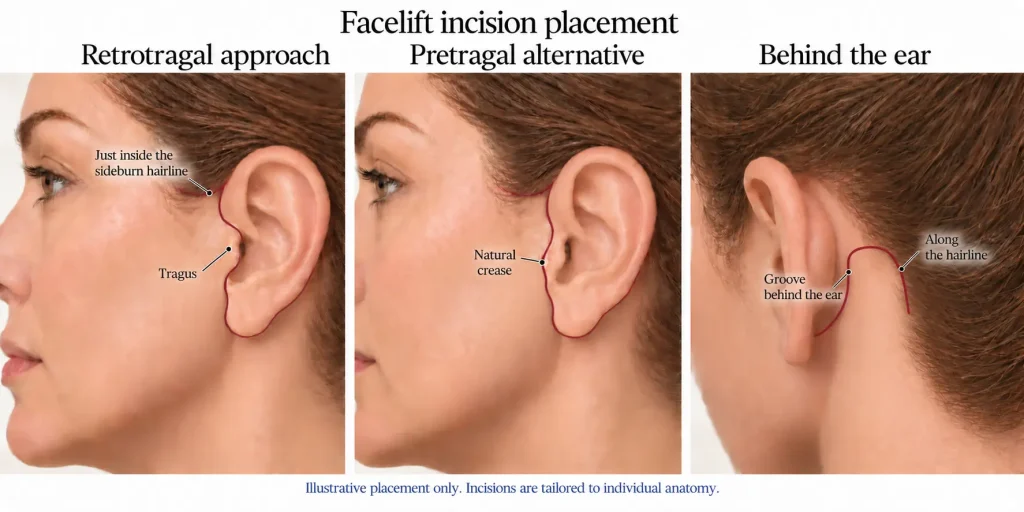
Where are facelift incisions placed?
The incision pattern depends on your anatomy, the areas being treated and how much skin needs to be removed. I aim to place scars at natural boundaries, where changes in contour or skin texture may help them blend into the surrounding area.
In front of the ear and around the tragus
The tragus is the small projection of cartilage in front of the ear canal. An incision can follow a crease in front of it, called a pretragal incision, or pass just behind its visible edge, called a retrotragal incision.
I most often use retrotragal placement. However, a pretragal incision may suit someone with a well-defined natural groove and similar skin texture across the cheek and tragus. It can also be useful in men to avoid moving beard-bearing skin onto the tragus. Your preference forms part of this discussion.
The aim is to position the scar discreetly while preserving the tragus and the natural contour at the entrance to the ear.
Around the earlobe and behind the ear
The incision follows the earlobe and continues behind the ear. I aim to keep the scar close to the groove behind the ear, with the transition towards the hairline positioned high enough to help conceal it.
A scar behind the ear is not necessarily invisible. Its appearance will depend on its position, how it heals and whether it is exposed by your hairstyle.
At the sideburn and temple
For a lower facelift, I do not routinely need to extend the incision into the temple. A more extensive lift addressing the cheek, lower face and lateral neck may require a different upper incision pattern.
Where an incision is needed near the sideburn, I generally favour following the hairline. If a temporal lift is combined with the procedure, I may be able to reduce the upper extent of the facelift incision. The plan is individualised, with attention to preserving the hairline and avoiding unnecessary displacement of the sideburn.
How I aim to preserve the natural shape of the ears
A fine scar is only one part of the result. The ear’s shape and attachment to the face also need consideration.
Excessive pulling can alter the tragus or draw the earlobe downwards towards the cheek. The latter is sometimes called a “pixie ear”, where the lobe appears stretched or more attached than it was before surgery.
My approach is to place the lifting support in the deeper tissues. Deep plane dissection releases selected retaining ligaments so the tissues can be repositioned. Depending on the planned extent, these include the zygomatic and masseteric ligaments in the cheek and the cervical retaining ligaments associated with the platysma in the neck.
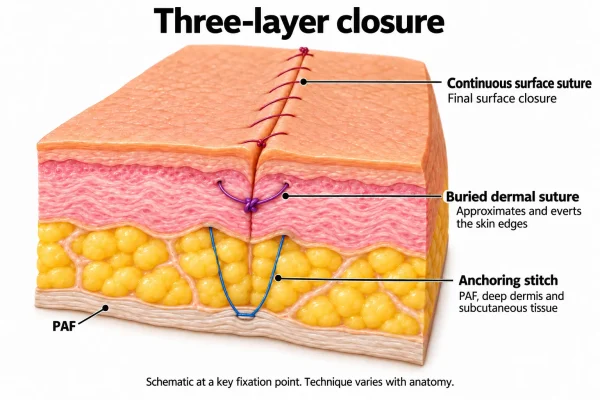
The supportive layer of the face, known as the SMAS, and the platysma are then secured. I redrape the skin with minimal tension and use anchoring points around the ear to help limit pulling on its contours.
These measures aim to reduce distortion and tension at the incision. They cannot eliminate the possibility of visible scars, changes in ear shape or the need for further treatment.
If an earlobe is already enlarged or has lost volume, we can discuss whether reshaping or fat transfer is appropriate. These are additional procedures with their own considerations and risks, rather than a routine requirement of facelift surgery.
Can a facelift be scarless?
A surgical facelift cannot be scarless. Even a small incision leaves a scar, although its location may make it less apparent.
When excess skin needs to be removed, an incision is necessary. The amount and distribution of that skin help determine the incision length. A shorter incision is not automatically preferable if it limits the ability to remove and redrape the skin appropriately.
Selected endoscopic lower face and neck approaches use limited incisions to reposition deeper tissues. In my practice, these are considered where skin excess is mild and the main objective is reshaping the underlying tissues. They do not provide the same capacity to remove substantial loose skin.
The consultation should clarify what a limited-incision approach could achieve for you and what it would leave untreated.
What facelift scars look like as they heal
The appearance at two weeks is very different from the appearance several months later. Healing also varies along the incision, so one area may settle more quickly than another.
The first two weeks
I use a multilayer closure with dissolvable buried sutures. Any surface sutures are generally removed in stages over 10–14 days, depending on healing.
Most of the incision is usually closed by around two weeks, although small areas can take longer. This does not mean that the scar is mature or that recovery is complete. Swelling, bruising and altered sensation may still be present.
Around two to six weeks
Scars may become redder, firmer, slightly raised or more noticeable during the early healing period. These changes can be unsettling if the incision initially looked finer.
They do not necessarily indicate a poor final result, but a progressively thickening or uncomfortable scar should be reviewed. Increasing pain, spreading redness, discharge, wound opening or sudden swelling also require prompt contact with the surgical team.
Over the following months
As collagen remodels, scars generally soften, flatten and fade. This process is gradual, and the six-week point is not a fixed turning point for everyone. Maturation can continue for 12–24 months or longer.
Some scars remain wider, raised or different in colour from the surrounding skin. Individual healing, skin characteristics, wound tension and complications can all influence the outcome. Smoking and some health conditions, including diabetes, can impair healing. Please tell us about previous problematic scars and any smoking or nicotine use before surgery.
Will I be able to wear my hair up?
Wearing your hair up or tucking it behind your ears may expose parts of the scar, particularly early in recovery. Incision planning aims to make these areas less noticeable, but complete concealment cannot be promised.
Tell me how you usually wear your hair during your consultation. Short hairstyles, an exposed hairline and a preference for ponytails are relevant to planning. During recovery, follow our advice about hairstyles and avoid pulling on healing incisions.
How we care for facelift scars at Unveil
Scar care is adjusted to how you are healing. At Unveil, postoperative support includes customised care through Unveil Aesthetics when appropriate.
Once the wounds have closed and we have confirmed it is suitable, I generally begin with silicone gel. Silicone tape or sheeting may be recommended for areas developing raised or thickened scarring. Sun protection is also important, including shade, a suitable hat and broad-spectrum SPF 50+ sunscreen on healed skin.
Your plan may include gentle massage, selected topical products or serums, and LED treatment. We advise when these can begin and what each is intended to address. Evidence and suitability vary between treatments; no product or device can guarantee a particular scar result.
From around three months, I may consider laser or microneedling if needed, depending on the scar and the state of healing. Raised scars may require other measures, including carefully selected corticosteroid treatment. Treatments carry their own risks and are chosen after assessment.
Do not start massage, active skincare or treatments over an unhealed incision without advice from your surgical team.
Looking closely at facelift scar photographs
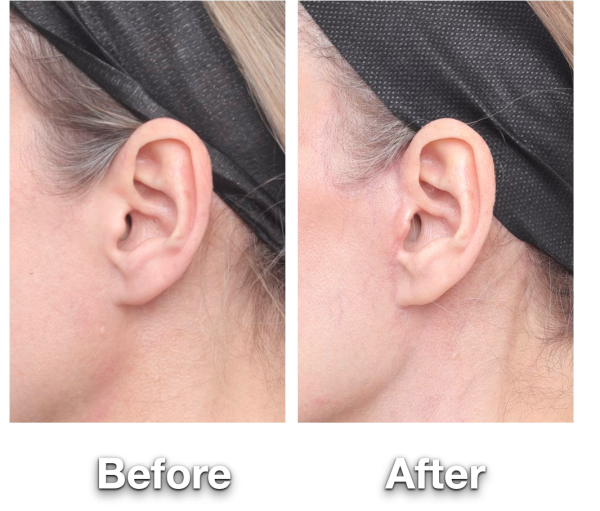
Close-up photographs can help you understand where incisions sit and how the ears look after surgery. It is useful to see the front of the ear, the earlobe, the groove behind the ear and the hairline, with the time since surgery clearly stated.
Images from the same patient at different stages can show the progression of healing. They should be viewed alongside the patient’s preoperative appearance, because ear shapes and earlobe attachments naturally vary.
One person’s photographs cannot predict your result. Lighting, angle, hairstyle and the stage of healing also affect how noticeable a scar appears. Photographs in this article are shown with patient consent; individual results vary.
Discussing your concerns at consultation
You are welcome to ask to see close-up examples of scars and ears from my practice. We can look at these together and discuss how your anatomy, skin, hairstyle and healing history may affect your own plan.
Useful questions include where your incisions would sit, whether the hairline or earlobe might change, what the recovery involves and what we would do if a scar remained noticeable. Choosing not to proceed is also a valid option if the trade-offs do not feel right for you.
Facelift surgery carries risks beyond scarring, including bleeding or haematoma, infection, delayed wound healing, skin loss, nerve injury, asymmetry and anaesthetic complications. Further surgery may be required. Your consultation includes discussion of the potential benefits, alternatives and risks relevant to you.
Next in this series
In a separate article, I will discuss endoscopic brow, temporal and upper cheek lift with fat transfer, including when these procedures may be considered for lateral brow heaviness, descended cheek tissues and volume loss. That discussion will also cover their limitations and risks, and how they differ from treatment with fillers.
Related reading: What Is a Deep Plane Facelift and How Is It Different?
Any surgical or invasive procedure carries risks. Before proceeding, you should seek a second opinion from an appropriately qualified health practitioner.